
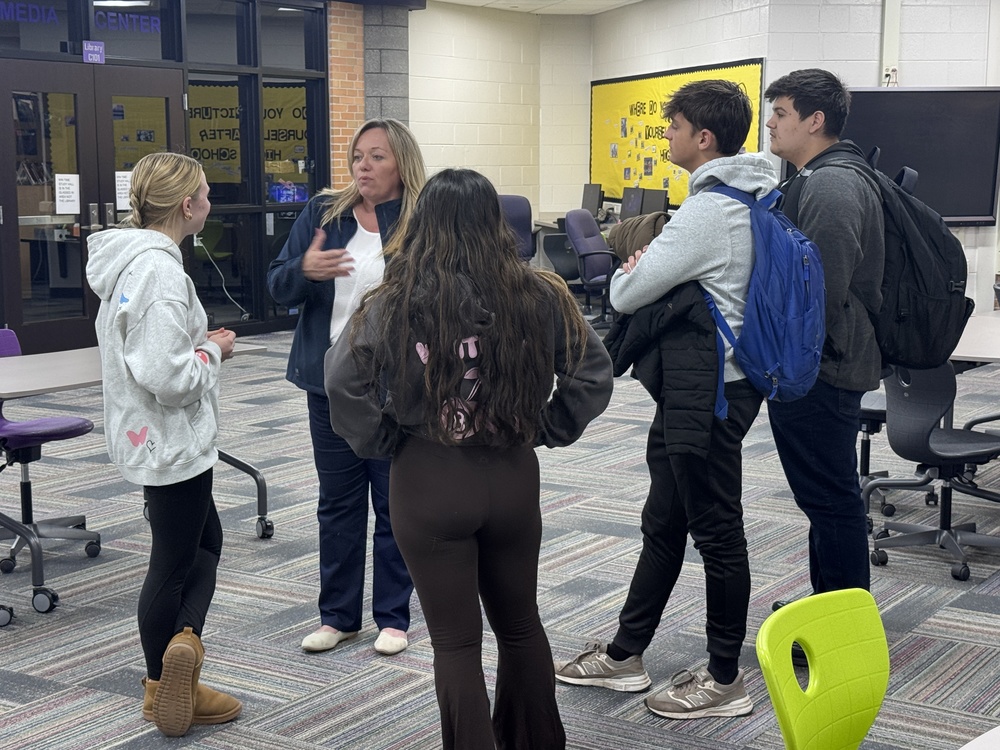
Woodhaven High School welcomed Michigan Representatives Jamie Thompson and Mark Tisdel on Tuesday, April 7, for a special speaking engagement hosted by the Students Civics Movement Club. The event, held in the PBLZ, gave students and staff the opportunity to hear firsthand about the representatives’ paths to elected office, their motivations for serving, and current legislative initiatives that will directly impact Michigan schools.
Representative Thompson shared her deeply personal journey into public service. After the passing of her daughter, Thompson began raising her grandchildren — now ages 8, 9 and 11 — an experience that reshaped her perspective and strengthened her resolve to serve others. A nurse by profession, Thompson said advocacy has always been central to her work, particularly supporting individuals in domestic abuse situations. Listening to people’s stories and helping represent families across Downriver ultimately inspired her to run for office.
She also reflected on how parenting in the digital age has evolved. While she once believed 12 was an appropriate age for a child to have a cell phone, she admitted she is now rethinking that decision. Thompson noted concerns about the rise of short-form online videos and social media content, describing much of it as distracting and often lacking meaningful value.
Representative Tisdel focused much of his remarks on the recently passed high school cell phone legislation, which will take effect next fall and impact all public K-12 schools across Michigan. The bill prohibits smartphone use during instructional time. Students in grades 7-12 will be permitted to use their phones between classes and during lunch, but devices must be put away during class unless a teacher authorizes use for a specific academic task. Districts will have the flexibility to implement stricter policies if they choose.
Tisdel explained that the idea began roughly seven years ago after he encountered research from behavioral psychologist Jonathan Haidt discussing the effects of smartphones and social media on young people. The research highlighted how smartphones are intentionally designed to capture and keep users’ attention, often contributing to addictive behaviors. “They are selling your attention,” Tisdel said, explaining that algorithms are built to continuously feed users content similar to what they have already engaged with.
Concerned about classroom distractions and Michigan’s declining education rankings — from 16th nationally in 1998 to 44th today — Tisdel began drafting legislation in June 2023. Over a two-and-a-half-year period, he worked with educators, parents, and fellow lawmakers on both sides of the aisle to refine the bill. The legislation ultimately passed with overwhelming bipartisan support: 99-10 in the House and 34-1 in the Senate.
Tisdel walked students through the legislative process, from working with the Legislative Service Bureau to draft the bill, to committee discussions, revisions, and collaboration across party lines. “A lot of the day-to-day work isn’t particularly exciting,” he said, “but it comes down to cooperation and representing everyone.”
The law applies to Michigan’s 537 local school districts, 56 intermediate school districts, and 293 academies and charter schools. Tisdel emphasized that Michigan invests approximately $21 billion annually in K-12 education, and lawmakers want to ensure taxpayers see a strong return on that investment. Reducing classroom distractions, he said, is one step toward getting “back to the basics.”
Woodhaven High School Principal Jay Vesperman shared that he has spoken with fellow principals to gather input on what they would like to see as the new policy is implemented locally.
During the event, students asked a variety of questions and shared their concerns about protecting young people on social media websites. One student also shared her experience in the foster care system and Representative Thompson was able to provide meaningful feedback and encouragement.
Both representatives emphasized the importance of accountability and accurate assessment data. Thompson noted that testing must provide meaningful and accurate results to truly measure how students are performing. Ultimately, both lawmakers said their goal is to ensure students are prepared for life after graduation — whether that means attending college, entering a trade, or beginning a career — and encouraging them to build their futures here in Michigan.
The event provided students with a valuable look at how laws are created, how bipartisan cooperation works in practice, and how state-level decisions can directly affect their daily school experience.